Sagrada Familia Tickets Online
Sagrada Familia is famous all over the world
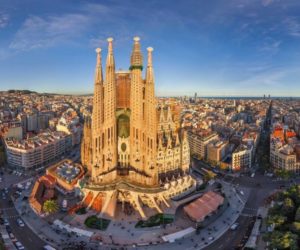
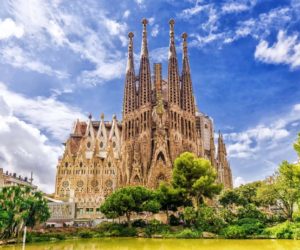
This is one of the most important and famous creations of architect Antonio Gaudi. It began to be built in 1882 and is still being built. But despite this, the Sagrada Familia impresses with its majesty, power and extraordinary beauty, which is characteristic of everything that Antonio Gaudi once did.
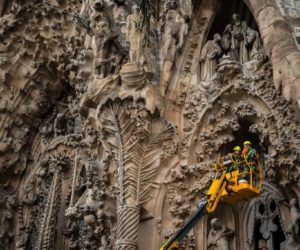
You Say «Barcelona» — you mean Sagrada Familia. One of the most visited attractions not only in Catalonia, but also in Europe as a whole, has managed to make so much noise for 137 years thanks to unusual architecture and «eternal» construction: no one believes that the scaffolding will be removed from the cathedral and it will be finished, even despite promises that it is planned to complete the grandiose construction by 2026.

Sagrada Familia: Opening Hours
November through February
- Monday through Saturday 9:00 am to 6:00 pm.
- Sundays 10:30 am to 6:00 pm.
March and October
- Monday through Saturday 9:00 am to 7:00 pm.
- Sundays 10:30 am to 7:00 pm.
April through September
- Monday through Saturday 9:00 am to 8:00 pm.
- Sundays 10:30 am to 8:00 pm.
Special opening hours
- On 25 and 26 December, 1 and 6 January, opening hours will be from 9:00 am to 2:00 pm.
Tickets can only be purchased online.
How to Get to Sagrada Familia
Sagrada Familia — Carrer de Mallorca, 401, 08013, Barcelona
Metro
- L2 and L5 — Sagrada Familia
Bus
- 19, 33, 34, D50, H10 — Sagrada Familia
Sagrada Familia: to Know Before You Visit
Initially, the architect Antonio Gaudi had nothing to do with it at all: the temple was built with the support of the «Spiritual Association of Devotees of St. Joseph» under the leadership of Francisco de Paula del Villar at Lozano, who planned to build a cathedral in the Neo-Gothic style.
In 1882, the first stone was laid, but a year later Francisco quarreled with the association and the construction was entrusted to a young architect Antonio Gaudi, who at that time could only boast of designing a workshop for bleaching cotton.
There are several theories as to why he was chosen for this position. According to one of them (more romantic), the chairman of the Association dreamed that a man with blue eyes should build a temple, and according to a more plausible one, the customers chose a promising but little-known architect because he simply cost them less.
However, later the estimate was exceeded several times, so the plan was not very successful. But all further construction was based on the idea that the temple should be created by people, that everything would be in the hands of God and human will.
At the same time, all donations must be anonymous, without implying any advertising, and neither the Spanish government nor private companies take part in them: the Sagrada Familia is created on donations from parishioners.
Thus, the construction of the temple has been going on for almost 140 years, architects and technologies have changed, but the idea remained unchanged: to create a church unlike others, with a unique architecture and in harmony with nature and God.
Antonio was very inspired by the project and enthusiastically embarked on it. When the construction of the crypt (underground vaulted rooms located under the altar and choral parts of the temple) was completed, a huge donation unexpectedly arrived and Gaudi decided to completely revise the project.
At the same time, the architect did not have a complete, final plan, he treated the Sagrada Familia as his child and believed that he should grow and develop freely (looking ahead, I would like to note that already in our time, when using computer technology, it was proved that intuition did not fail the architect and everything was designed and built with amazing precision).
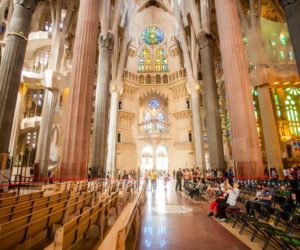
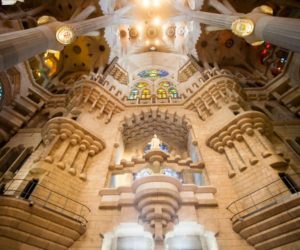
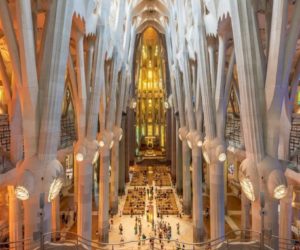
Gaudi drew inspiration from nature and that is why the temple is unlike any in the world: inside you can feel like in a fairy forest, and indeed, sometimes you just forget that you are in a functioning church.
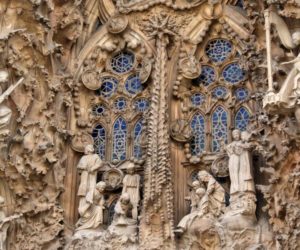
The construction was started from the facade of the Nativity (the Passion of Christ and the Resurrection were also planned), because the architect did not want to immediately scare the residents with death, heavy and terrible events.
As a true believer, Antonio could not allow the creation of human hands to be higher than the creations of God, so the height of the temple towers was planned to be one meter lower than the highest point in Barcelona at that time, Montjuic Mountain.
Gaudi devoted more than 40 years to the construction of the temple, while tirelessly repeating that he had nowhere to hurry. «My customer is God, and he is in no hurry.» During his lifetime, one of the towers of the Nativity facade was completed and the Passion Facade project was created.
After the architect’s death in 1926, the construction was continued by his students and associates according to the remaining drawings. During the Civil War of 1936-1939, some of the models were destroyed, but later something was restored, and now with the help of new technologies, the construction is nearing its completion.
Legends and Facts
Gaudi took a responsible approach to work, gushing with ideas, painting abstract paintings, rebuilding and discovering new opportunities for himself. He was so inspired that he dreamed of creating the most realistic objects. For example, for casts of infants, he used real stillborn children, and animals for the same purpose were temporarily put to sleep with chloroform.
In 2008, 400 (!) famous artists came out with a sharp criticism of the construction, which, in their opinion, has turned into a tourist attraction and has long had nothing to do with Gaudi’s original ideas.
Moreover, if you count the number of tourists visiting the attraction and add up all the money they spent, then perhaps it would already be possible to build several similar temples.
The facade of Passions is called «Star Wars» by locals because of the similarity of the figures of Roman legionnaires with the warriors from the mentioned film. In fact, similar characters can be seen on the roof of the La Pedrera building, also designed by Antonio Gaudi.
During the construction, a school was erected on the territory of the temple for the children of workers who were in class next to their fathers working on one of the most ambitious projects in Europe. Subsequently, the school was moved to another location.
Sagrada Familia is not the main church of Barcelona. The cathedral is located in a different place, and Sagrada has been a basilica since 2010 and is not the seat of a bishop, that is, an ordinary temple (if you can even use the word «ordinary» in relation to such an architectural masterpiece).
Each of the towers, future and already built, has its own meaning. There should be 18 of them in total and they symbolize the 12 apostles, 4 evangelists, the Virgin Mary and Jesus Christ himself.